Which Surrealist Artist Was Influenced by the Way That Children Made Art?
Idue north the wake of Earth War One, Surrealism entered into the art world like a storm wreaking havoc on any preconceived ideas the people of Paris may accept had about the nature of reality, art, and the man mind. Drawing upon theories in psychoanalysis, this revolutionary art motility reached deep into the psyche. Past provoking intense intellectual and emotional inquiry in this way, it changed the confront of modern fine art.
Table of Contents
- 1 What Is Surrealism?
- 2 The Nativity of Surrealism Art
- 2.1 Surreal Influences
- 3 Surrealist Literature, Sculpture, and Movie theater
- 3.1 Literature
- 3.2 Sculpture
- 3.iii Movie house
- iv Notable Surrealist Artists
- four.i Salvador Dali (1904–1989)
- 4.2 Pablo Picasso (1881-1973)
- 4.3 Joan Miró (1893-1983)
- v Surrealist Styles and Techniques
- 5.one Automatism
- 5.2 Frottage and Grattage
- five.iii Freeform
- 6 Surrealism Today
- 7 Frequently Asked Questions
- 7.1 What Is the Master Idea of Surrealism?
- 7.2 How Is Surrealism Used Today?
- 7.3 What are the Characteristics of Surrealism?
- 7.4 What Is an Example of Surrealism?
- 7.v What Are Some Techniques Used to Brand Surrealism Art?
What Is Surrealism?
The give-and-take Surrealism refers to an art move that entered the unsuspecting art world in the mid-1920s. It was officially founded by André Breton, a Parisian poet. Surrealism became a formal art motility, with a strong political, philosophical and social undercurrent that defined the methods used to elicit shock and curiosity among its following. Its footing-breaking endeavour to cut through the pre-existing norms of the fourth dimension spread to Europe and the USA in the 1920s and 1930s.
Surrealist art was an outcry confronting the rationality that its proponents saw as a dominating and destructive forcefulness in society, and indeed in the minds of people, that was responsible for much of the social ills of the time. Through cinema, art, and literature, Surrealist artists let their unconscious minds have center phase equally they used a variety of techniques to map the clockwork of their dreams and innermost imaginings.
While Surrealism allowed a platform for the exploration of their unconscious minds, Surrealist artworks also encouraged viewers to explore and evaluate theirs, through distorted and bizarre imagery that was inspired non past logical, rational thinking, only rather the absurd events and images that emerged in the dream-state, or images that were derived simply from uninhibited gratuitous-form drawing or painting.
These shocking, illogical, and challenging compositions were not leap to the confines of the rules and social mores that were seen to govern art and society at the time, and which people might expect from art.
The Birth of Surrealism Fine art
The menstruum surrounding the world wars was fraught with scenes of violence and horror, and it was his own experience as a nurse that inspired André Breton to write his first few poems. In 1924, Breton published The Surrealist Manifesto, which summarized answers to the question "what is Surrealism?". The Manifesto covered the range of ideas that underpinned surrealism every bit a motion that was inextricably linked with psychoanalytic theories of the unconscious equally a force that was behind all creative endeavors. His Surrealism art definition was as follows:
"Let us non lose sight of the fact that the idea of Surrealism aims quite simply at the total recovery of our psychic force by a ways which is naught other than the boundless descent into ourselves, the systematic illumination of hidden places, and the progressive darkening of other places…"
The motility became notorious for existence exclusive and rejecting members because they were not seen to adjust to the ideals put described in the manifesto. Breton drew upwardly a revised version of the manifesto in 1930, to describe an updated version of his Surrealism art definition.
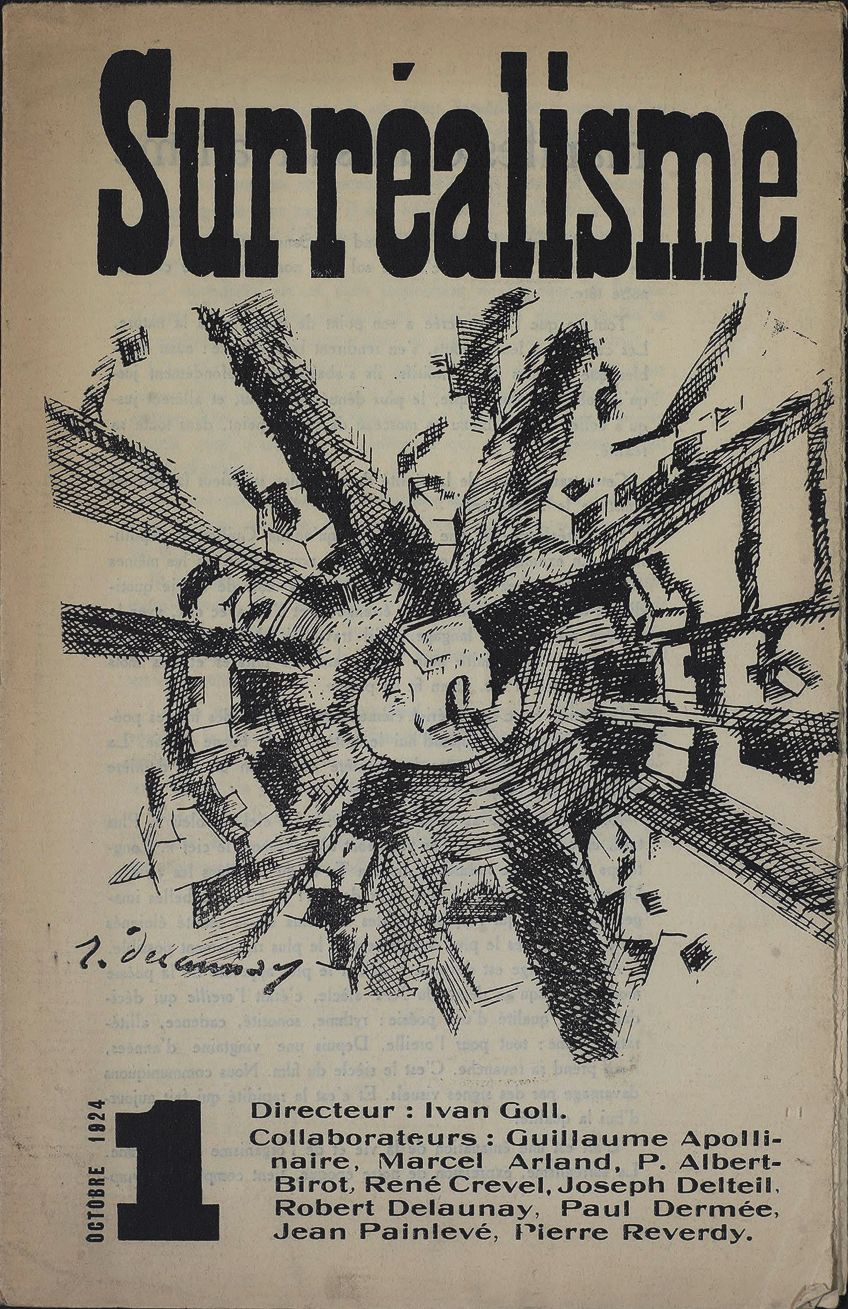 Robert Delaunay's illustration on the cover of Yvan Goll'southward Surréalisme, Manifeste du surréalisme,1924; Robert Delaunay, Public domain, via Wikimedia Eatables
The movement was named later on Guillaume Apollinaire, an innovative poet, and art critic, who was the commencement to utilise the word "surrealist" as a subtitle for one of his most scandalous plays. He was widely known as an art critic and fellow member of the Cubist art movement and was a source of swell inspiration to the adjacent generation of artists whose artwork embodied the characteristics of Surrealism.
The showtime Surrealist exhibition to take place was La Peinture Surréalist, which was held in Paris. Information technology took place in 1925 in Paris and featured the works of Pablo Picasso, Man Ray, and Paul Klee (among many others).
Originating in Paris, the Surrealist fine art movement soon swept through Europe, claiming the imaginations of many artists at the time. And, although Surrealism became notorious for banishing those who were institute not to conform to the ideals that defined the motility, information technology soon took hold of artists in the Us when many of the major Surrealist artists had no other option merely to flee Europe and to move, and exhibit their art and philosophy, in the USA.
The contagious ideals of this movement that challenged the bedrock of social club spread like wildfire in the art world there. Surrealism also influenced artists in Southward America.
Surreal Influences
Surrealism art was unlike other art movements in the way that it took a step into deeper aspects of the human experience, daring to delve into deeper realms untouched by other artists to summon to the calorie-free hidden parts of the human unconscious.
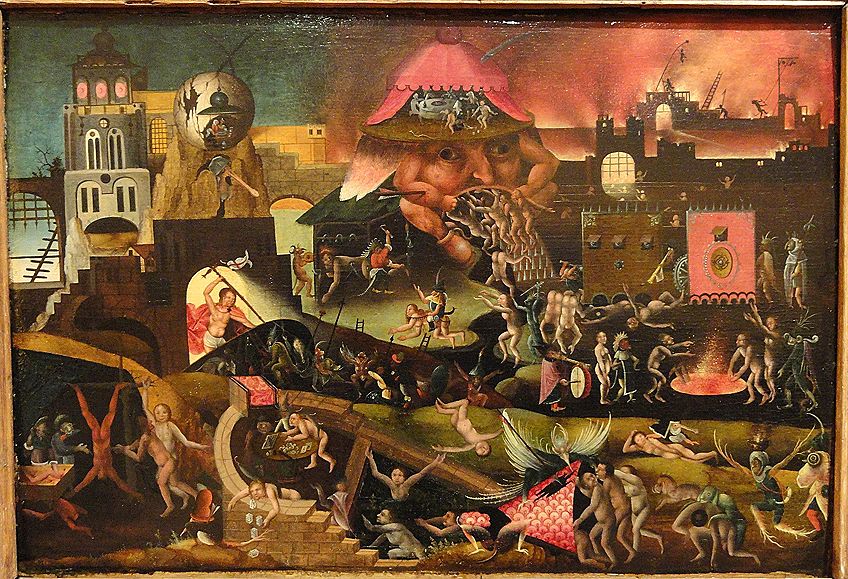 Christ in Limbo(1550) by a follower of Hieronymous Bosch;Follower of Hieronymus Bosch, Public domain, via Wikimedia Commons
Only information technology was also multi-faceted in the sense that it was non defined by a specific style or combination of artistic elements. Similar most other artforms, Surrealism was influenced by other artists and other fine art movements. Specifically, it was influenced by, for example, the images brought to life by artists similar Hieronymus Bosch and Francisco Goya. Other artists that inspired the Surrealist movement included Odilon Redon and Marc Chagall.
Dadaism
Surrealism inherited its fierce opposition to rationality from Dadaism, which was an art movement that shook early 20th century Europe and New York. The Dada movement was created in protest to the war, and the social and cultural structures that were characteristic of the time.
Artists that identified with information technology used spontaneity, teamwork, and gamble or luck to produce their work. Challenging traditional, rigid approaches to art, they focused mainly on creating collage and photomontage rather than the more traditional painting and sculpture to redefine the meaning of art.
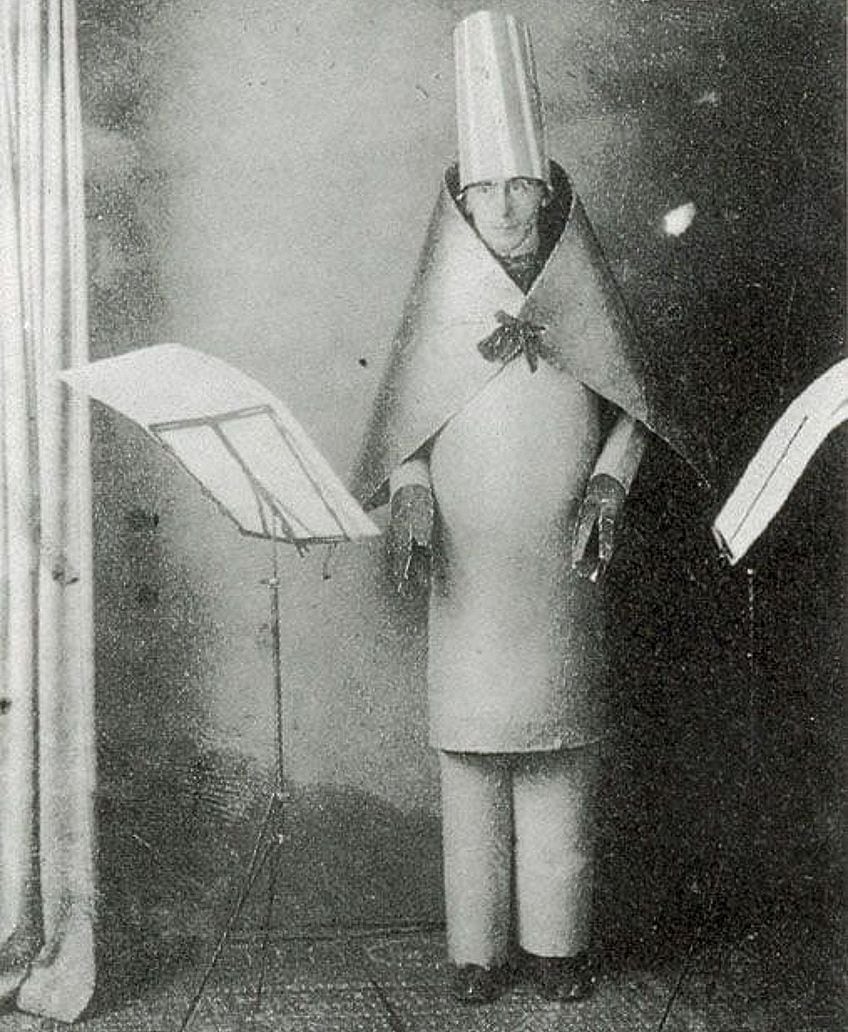 Cabaret Voltaire(1916) by Hugo Ball;Unknown author Unknown author, Public domain, via Wikimedia Commons
Although there was a definite socio-political flavor to Surrealist art, the heart of the motility lay non in replicating other artworks or ideas, but in being a highly personal projection that invited both the artists and the viewers to relinquish all conceptions of what art should be and plow inward. This self-reflection opened up space for what the Surrealists regarded as the ultimate reality to take form through the super-imposition of the conscious with the unconscious, resulting in a creative work that escapes the understanding of the rational listen.
This experimental entry into the deeper world of the subconscious plant its origin in the psychoanalytic works of Freud and perhaps Jungian ideas as well. The role of dreams, therefore, played an inevitable office in defining some of the content that was included in several paintings.
The Agency for Surrealist Enquiry
In addition to the publication of The Surrealist Manifesto in 1924, this year as well saw the formation of the Bureau for Surrealist Enquiry in Paris. This was a drove of artists and writers who were concerned with building a portfolio of information relating to how the unconscious mind reveals itself.
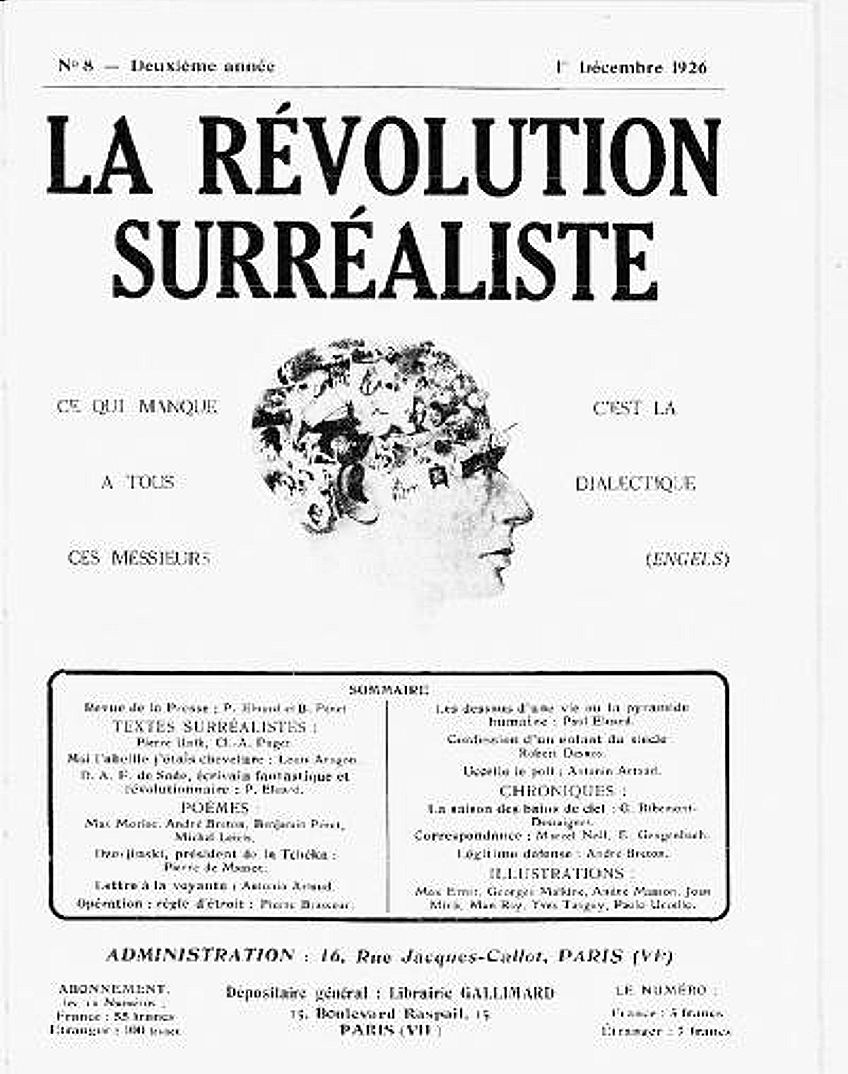 Comprehend of La Revolution Surrealiste Magazine, Volume 8,1926; Commonage, Public domain, via Wikimedia Commons
This information was collected in two ways. Firstly, information technology was collected through recording dreams. Secondly, a record was kept of the behavior and responses of the people who visited the office. In the same twelvemonth, the journal La Revolution Surrealiste started beingness published, which included the writings of Max Ernst and Man Ray.
Surrealist Literature, Sculpture, and Picture palace
Although art is the almost well-known expression of Surrealist ideas, these passionate philosophies, that brought taboo and repressed topics to the fore, had a strong presence in literature, sculpture, and cinema every bit well.
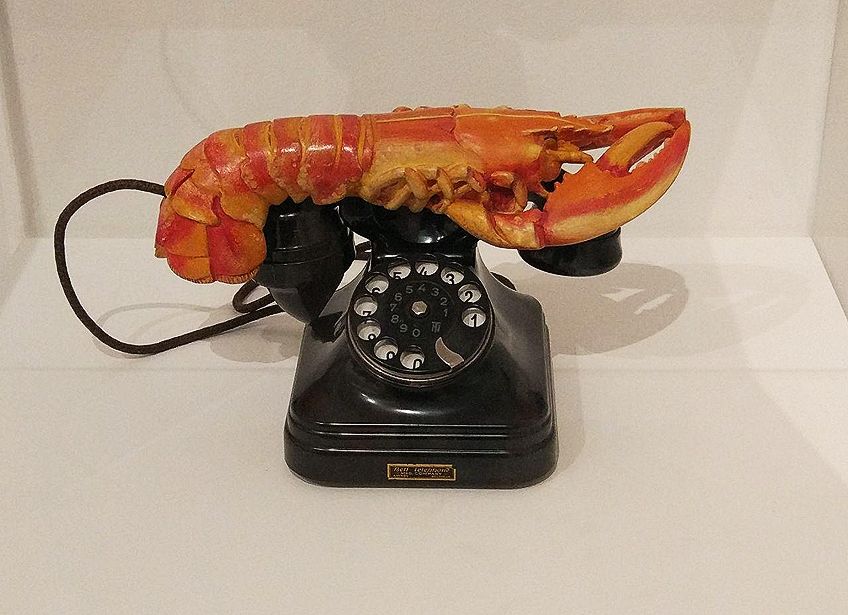 Lobster Telephone(1936) by Salvador Dali;Nasch92, CC By four.0, via Wikimedia Eatables
Literature
The first text, Les champs Magnetiques (The Magnetic Fields) that claimed the identity of being associated with "Surrealism", and which used the technique of automatic writing, was written past André Breton and Phillipe Soupault.
Notable Surrealist poets include André Breton, Paul Éluard, Louis Aragon, Pierre Reverdy, Michel Leiris, Antonin Artaud, René Crevel, and Robert Desnos. The words, through the poets, were the vessels or the conduit for the conscious expression of the unconscious.
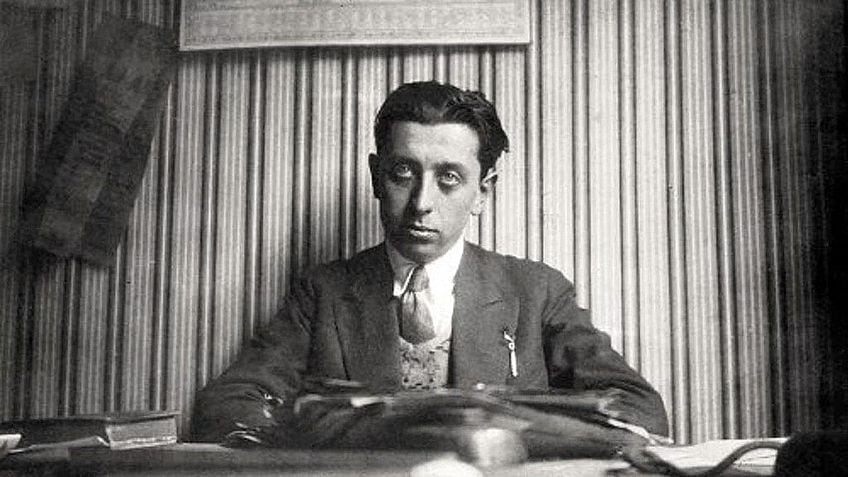 Photograph of Robert Desnos taken in 1924;Menerbes, CC BY-SA 3.0, via Wikimedia Commons
In addition to Surrealist poetry, a number of journals were published betwixt 1920 and 1940 equally well, including La Révolution Surréaliste, Le Surréalisme au service de la révolution and a magazine called Minotaure.
Sculpture
Surrealism sculptures embodied the same principles every bit the other forms of Surrealism, merely they introduced the chemical element of 3-dimensionality and touch to the idea of bringing the unconscious to life. This made the artwork more interactive and accessible to the viewer.
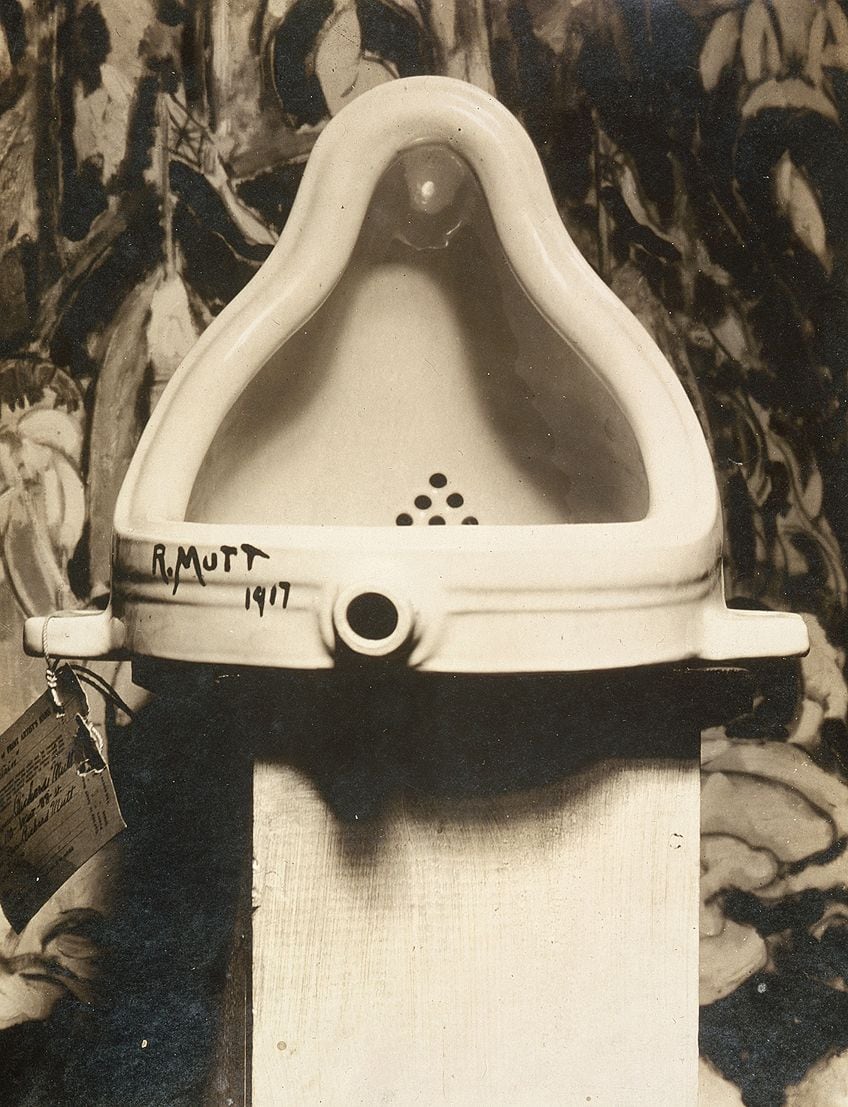 Fountain(1917) by Marcel Duchamp;Marcel Duchamp, Public domain, via Wikimedia Commons
Surrealism sculptures may non be every bit pop equally the paintings, just they have had a lasting influence on creative art in the 21st century. Some of the most widely known sculptures include the work of Man Ray and Marcel Du Champ.
Cinema
Surrealist cinema is relatively unique when compared to other styles, in its expression of the unconscious, or dream-like state, non but through imagery and story but in the style that information technology is compiled in an illogical and oftentimes unpredictable mode. Like Surrealist painting, Surrealist films share a few characteristics in common that relate non then much to content as to the way the films are compiled to bring people out of their comfy cocoons of ignorance or inactivity.
Luis Buñuel is considered one of the key figures in the establishment of Surrealist movie house, which was aimed at stimulating thought and bringing out intense emotional responses, often achieved by playing on people's fears. The Seashell and the Clergyman (1928) is widely held to be the first official Surrealist movie. It was the collaborative encephalon-child of past Germain Dulac and Antonin Artaud.
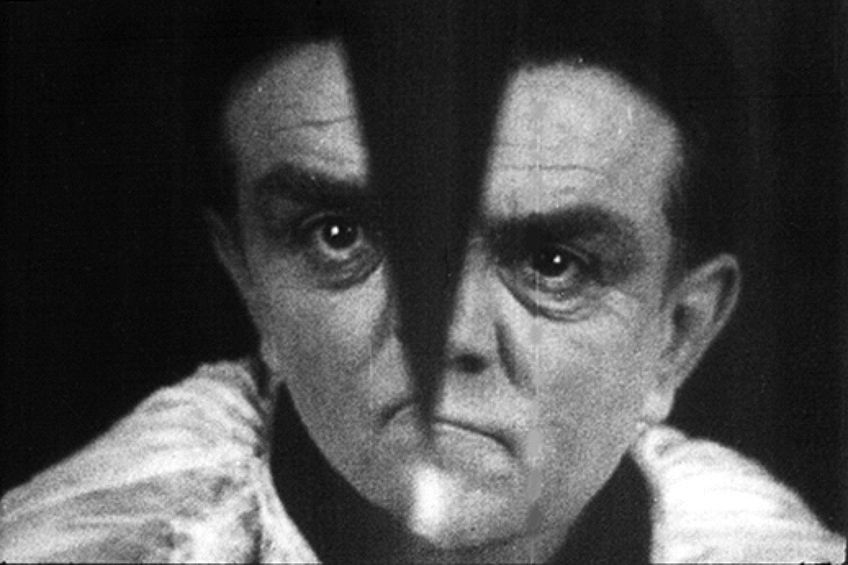 Frame from the movieThe Seashell and the Clergyman (1928) by Germaine Dulac; Germaine Dulac (1882-1942), Public domain, via Wikimedia Commons
Surrealist films contain a considerable dose of shock-value, accomplished peradventure by bombarding the audience with shocking imagery that may or may not resemble dreams and nightmares, and with the presentation of objects in contexts, one wouldn't normally associate them with. Add to this, characters who seemingly lack a moral compass and a plot that does non accept a chronological menstruation, and y'all take a classically Surrealist flick.
Notable Surrealist Artists
In its hey-solar day, the tenets of Surrealism were represented by many artists from all across the earth. Although Surrealism started in Paris, the membership of the Surrealist art movement reflected the cosmopolitanism of Europe itself. Many of the towering figures that bore the Surrealist flag with integrity and flourish were from various cultures, including Kingdom of spain, Germany, and Holland, not to mention New York.
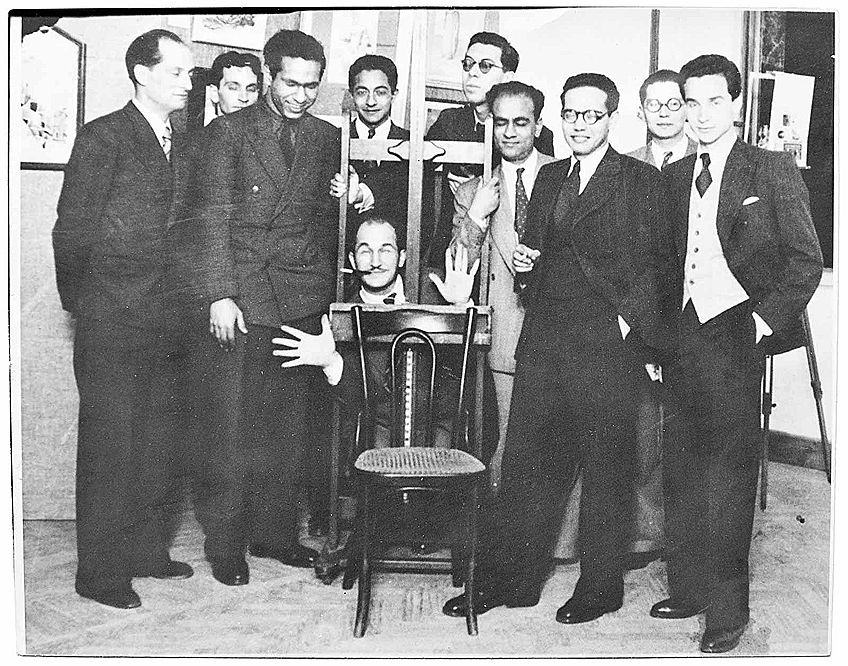 Photograph of the Members of the Art et Liberté Group, an Egyptian Surrealist group. Forepart row, left to correct: Jean Moscatelli, Kamel el Telmissany, Angelo de Riz, Ramses Younan, Fouad Kamel. Dorsum row, left to right: Albert Cossery, unidentified, Georges Henein, Maurice Fahmy, Raoul Curiel (1941);The Younan Family Archive, Public domain, via Wikimedia Commons
The move captured the spirit of the tumultuous time after the war, and the feelings in the backwash transcended international boundaries. Some of the more famous works that have stood the test of fourth dimension include those of Salvador Dali, Pablo Picasso, Jean Arp, Yves Tanguy, Human Ray, Andre Masson, Leonora Carrington, and Rene Magritte.
Salvador Dali (1904–1989)
Assimilating several artistic styles in art schoolhouse, Spain-born Salvador Dali's work flew to new heights in one case he started exploring the works of Freud, and when he started associating himself with the Surrealist movement. These influences are clearly evident in his early work.
Notwithstanding, subsequently in his career, his political views started to deviate from those of the Surrealist movement, and, for this reason, he was told to leave. His work started to have on a different flavor, cartoon inspiration from artists such equally Raphael, the Renaissance artist. The creative blood ran thick through Dali, and he connected to bring his creative flair to other endeavors like interior decorating for loftier-end stores and designing jewelry.
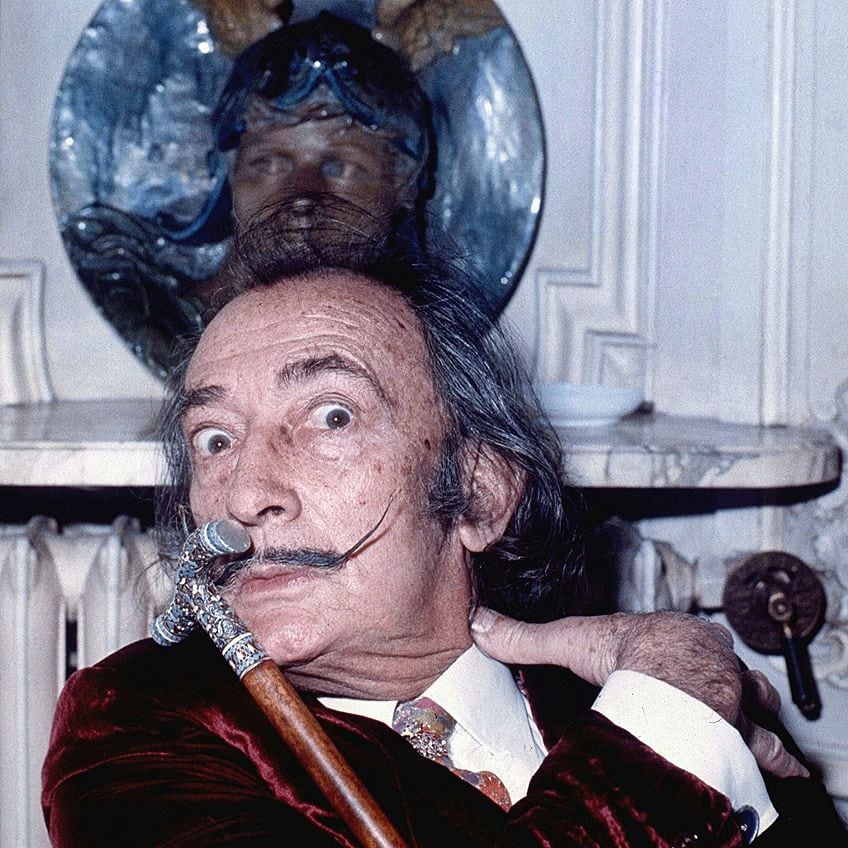 Portrait of Salvador Dali, taken in Hôtel Meurice, Paris (1972) by Allan Warren;Allan warren, CC Past-SA three.0, via Wikimedia Commons
One of the methods that Dali used to break the shackles of his mind, was to induce a hypnotic country through what he called the "paranoiac-critical method". This involved him intentionally making himself paranoid, making irrational associations between things that weren't related, to reach a delusional state that provided the basis for the images that he included in his art. The legend of Dali is still live in modern culture not only considering of his art and method. He had a way of embodying the absurd, of bringing his inventiveness to life through life itself.
Persistence of Retentivity (1931)
Dali was and notwithstanding is, known for his wide range of surreal paintings. 1 of the most famous works that take him etched in the annals of time as ane of the predominant figures in the Surrealist movement is The Persistence of Retention. Despite its enormous presence in the history of art and modern culture, the painting is apprehensive in size – slightly larger than a piece of paper and is exhibited at the Museum of Mod Art in New York Urban center. Dali brought this painting to life at the tender age of 28.
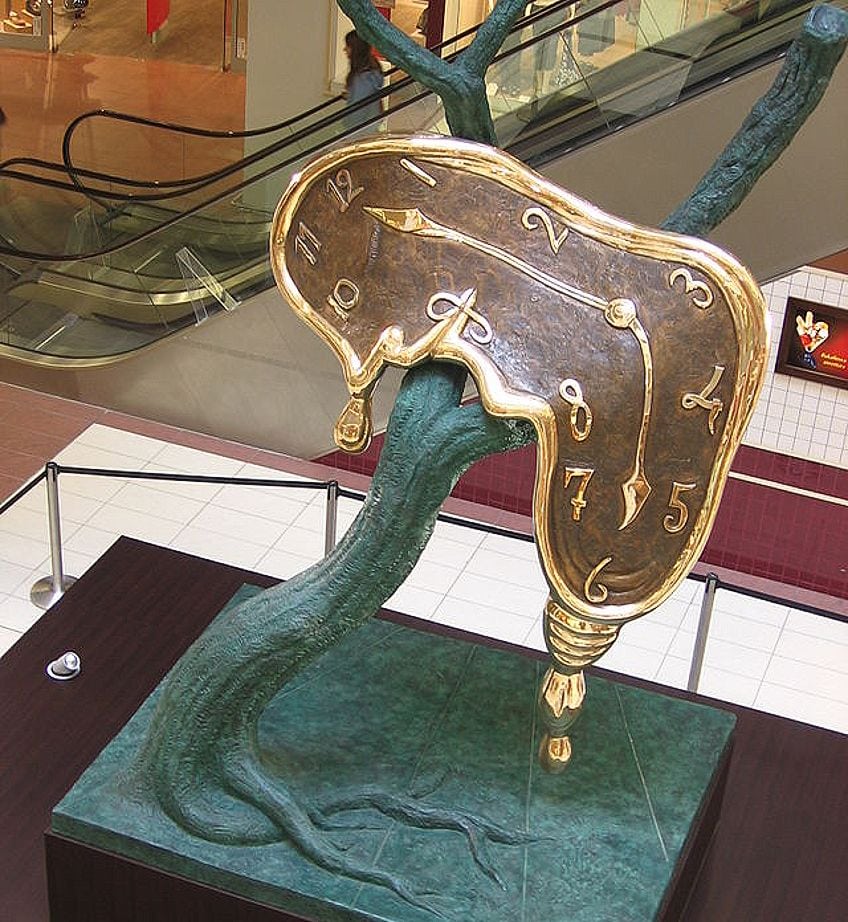 Profile of Time(1984) past Salvador Dali; Julo, Public domain, via Wikimedia Commons
The Persistence of Memory is presented as a deserted mural, interrupted simply by melting clocks that are draped over a dead tree. There is likewise a shape-less flesh-colored object near the centre of the painting (which Dali claimed to be a representation of himself), upon which another clock is unceremoniously draped. This landscape has been identified every bit Dali'south hometown, Catalonia.
Pablo Picasso (1881-1973)
Pablo Picasso is another creative person whose legend remains with united states of america today. The son of an art professor in Spain, Picasso grew upwardly under the fly of his father. Early on on in his career, however, he deviated from the traditional art forms that he had come to know as a child.
Although Picasso is more than ofttimes associated with Cubism (beingness one of the founders of this motion), his later work was influenced by Surrealism in a big way. Never quite an official member of the movement, he was strongly continued with many of the major proponents of the movement, including Breton himself. His fine art embodied some of the Surrealist ideologies that made the Surrealist movement what it was.
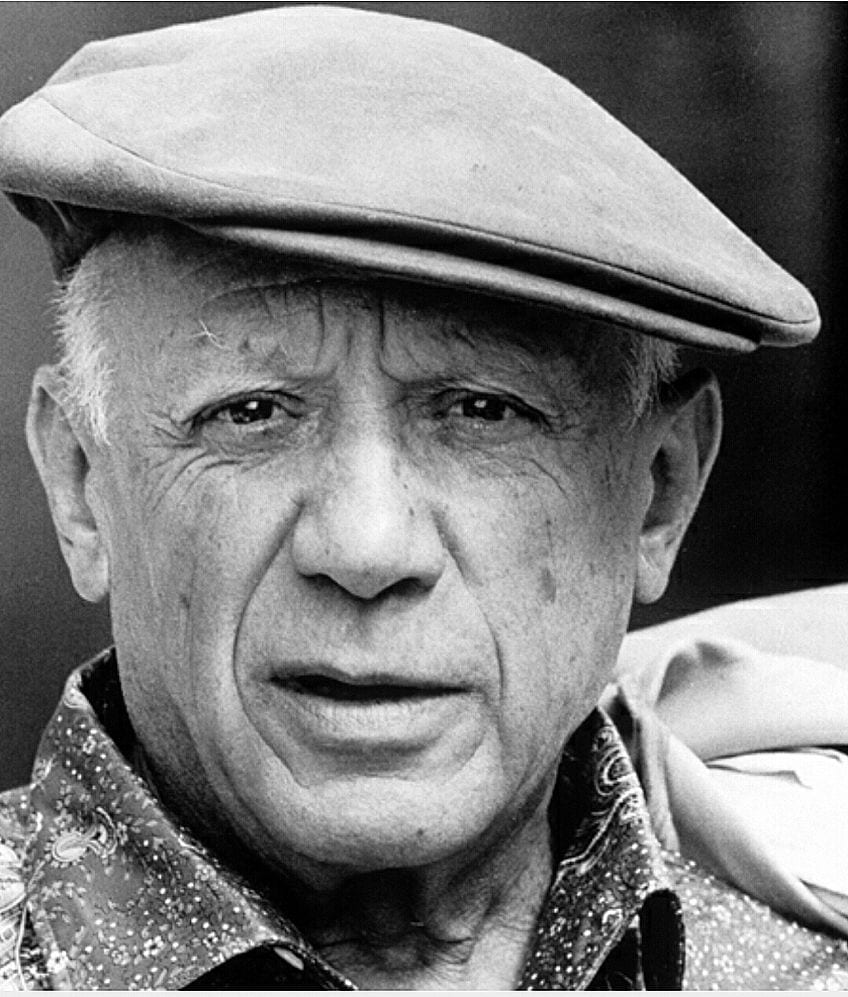 Photo of Pablo Picasso taken in 1962; Argentina. Revista Vea y Lea, Public domain, via Wikimedia Commons
He spent a period of his life moving betwixt France and Espana. Eventually, though, the colorful bourgeois life of Paris took concur of his imagination after he was swept off his anxiety by the passion and romance of the intellectual and artistic flair that characterized the Parisian temper in early the early 20th century. He found himself unable to resist the temptation of finding passage to stay in France on a more permanent basis.
Although best known for the distorted imagery he brought to life through his painting, Picasso channeled his creativity into sculpting, ceramics, and poetry too. By the end of his lifetime, he had conjured into existence more than twenty,000 pieces of fine art, including prints, ceramics, and costumes.
Picasso'southward painting changed in style considerably over his lifetime. Some of the paintings took on the distorted, nigh dreamlike quality of surrealist artists. At other times, though, his style of painting took on the awkward juxtaposition of various geometric shapes to make up everyday objects, figures, and portraits.
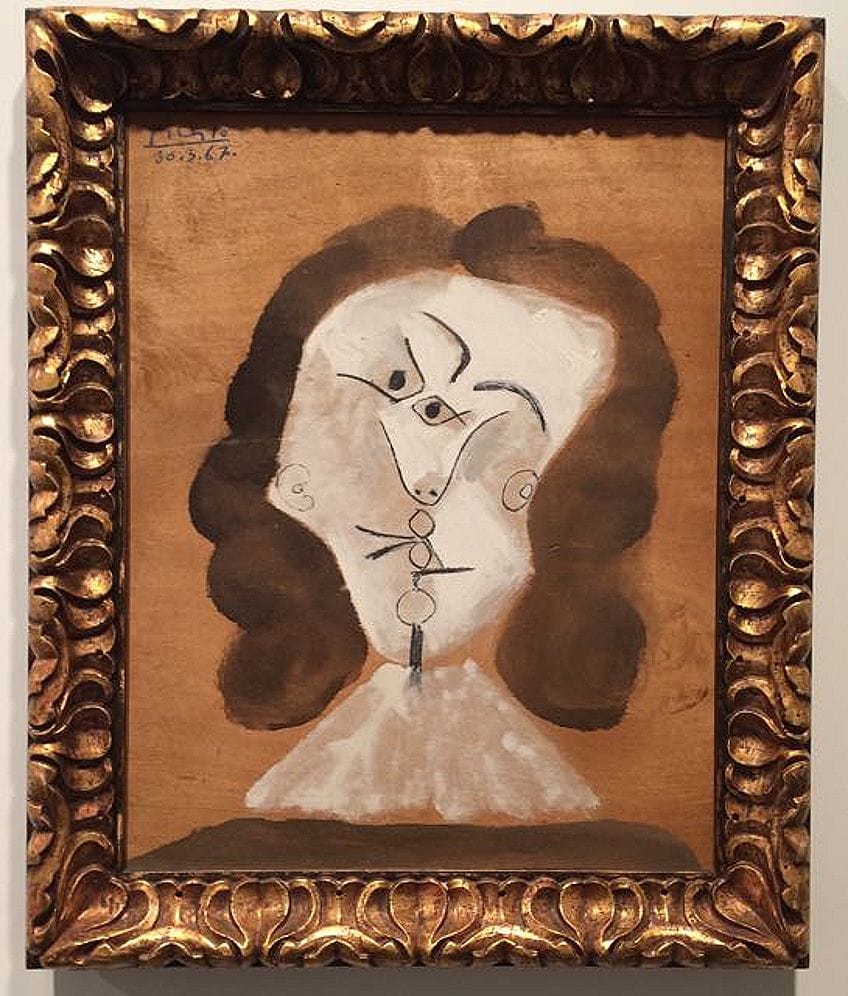 Mousquetaire, Tête(1967) by Pablo Picasso;Mika58, CC BY-SA four.0, via Wikimedia Commons
Picasso'southward work was, to some extent, defined past the colors he was using during unlike periods in his life. Some of the early on paintings he created in Kingdom of spain, for example, have been grouped into a category chosen "the Blue Period", as they comprised mostly dejection. Upon arriving in France, he took on a more rose-colored tone to his work. Hence, some of his paintings that emerged from the honeymoon stage of his life in France vest to the "Rose Flow" of his paintings.
Although non all of his paintings were political, nor conformed to the Surrealist ideals, Picasso summarizes his stance of the meaning of creative life: "Painting is not fabricated to decorate apartments. It is an offensive and defensive weapon against the enemy."
The Ruby Armchair (1931)
Picasso had intimate relationships with different women throughout his life, each inspired him. Indeed, changes in his painting way can exist seen to correspond with the entry of a new feminine muse into his life.
One of his famous Surrealist paintings, The Cherry-red Armchair is a portrait of Marie-Thérèse Walter, a married adult female who was 28 years older than Picasso. It shows a woman sitting on a chair with a frontal and side view of her face up.
This dual perspective is sometimes interpreted equally an acknowledgment of their secret affair. This painting was i of many portraits of Walter that were created for an exhibition at Galeries Georges Petit.
In this painting, Picasso uses industrial house paint (Ripolin) in creative and practiced means. He was fond of this medium considering of the solid finish it gave by pouring it straight onto canvas, and considering of its brilliant colors. In this painting, he mixed the pigment with oil to produce interesting furnishings.
Joan Miró (1893-1983)
Breton described him equally ane of the best examples of a Surrealist artist. Today, he is considered to be an abstract creative person with distinctly Surrealist qualities. Different Picasso, Miró did not abound up under the artistic influence of his parents who insisted that he become to commercial higher; his father was a watchmaker and goldsmith.
Miró had a breakup afterwards having worked as a clerk for two years. At this point, he started studying art and had a teacher who sympathized with his need for engaging concretely with the subjects he was painting.
Early in his creative career, Miró focused on painting landscapes, portraits, and nudes and was influenced largely past Fauvism and Cubism at that fourth dimension, but the content of what he painted and the philosophy that underpinned his artistic creations had strong similarities with Dadaism and Surrealism. Information technology was mainly betwixt 1925 and 1928 that his artwork started to metamorphize into truthful Surrealist paintings in the way that they depicted imaginary scenes that resembled the dream-world. He signed The Surrealist Manifesto in 1924.
Like the other artists, he was also struck by the cultural upsurge in Paris and for many years he, like Dali, traveled between his country of origin and France. Like many other artists of the age, he felt moved past the atrocities of the war also equally the socio-political climate of the time and used art to communicate his political views and mood.
At a later on stage, he started working with José Llorens in the pottery world, making artistic choices that challenged people'due south expectations of the art class, in a very Surrealist way.
Dog Barking at the Moon (1926)
The Domestic dog Barking at the Moon is i of Miró'southward most well-known paintings. Information technology came into being while he was living in Spain. This painting depicts an animal that vaguely resembles a dog, with a ladder on the left stretching into the night sky. The moon is on the far right of the picture, painted with a cherry-red nose and a heart. It is set confronting a night sky on an eerie surface that, to no pocket-size degree, reflects the alien mural of Catalonia, where the artist grew up. The Surrealist qualities are no mystery in this painting, and information technology has a humorous quality to it that became feature of Miro'due south later work.
Surrealist Styles and Techniques
Surreal paintings were defined not so much by recognizable characteristics than by the philosophy that inspired the use of certain techniques to convey the intention of the artwork and allow it to accomplish its aims. Some of the Surrealist work of Picasso, for instance, is dissimilar in style to that of Max Ernst. Artists inverse their styles over time and even tended to use dissimilar styles and techniques in a single artwork.
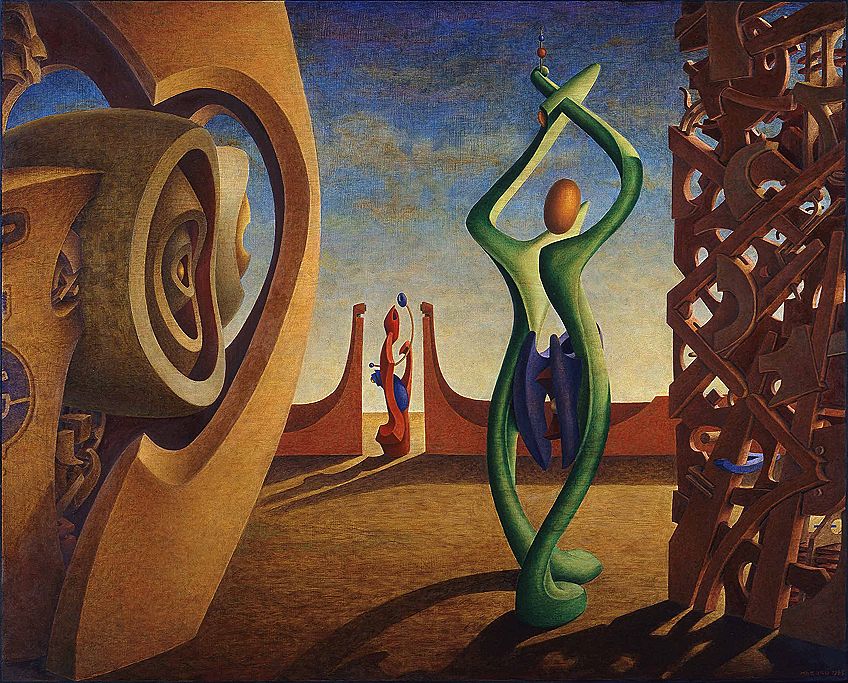 Les Voix Intérieures('Inner Voices', 1985) by Didier Mazuru;Didier Mazuru, CC Past-SA four.0, via Wikimedia Eatables
Some of the techniques used include automatism, collage, frottage, and grattage. To rescue the "object" from its unfortunate fate of being victim to interpretation in terms of over-familiar contexts, Breton refers to "estrangement" as the process of removing objects from the normal circumstances in which nosotros wait to see them and placing them in an entirely new one. This allows viewers the opportunity to develop a new understanding of that object that is not influenced by civilisation.
Automatism
One of the defining features of the relentless mission of Surrealism to challenge people to peer into their subconscious is referred to as "automatism". This practice allowed for creativity to emerge unfiltered by the rational listen and rules that governed traditional artistic pursuit. Automatism is frequently used in writing, where the author allows a stream of words to menstruum uninhibited, and the aforementioned process was applied to Surrealist painting.
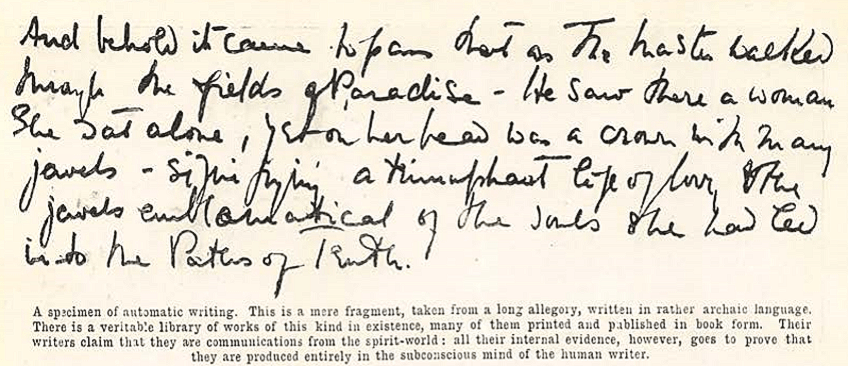 Automated writing demonstrated past the sorcerer William Marriott in 1910;William Marriott, Public domain, via Wikimedia Eatables
Frottage and Grattage
Surrealism is defined more than by the underlying philosophy that informs the content that is portrayed, rather than being express to a sure medium or style. Still, some techniques were developed which many artists felt helped to make the artworks entice the viewer into thinking more laterally.
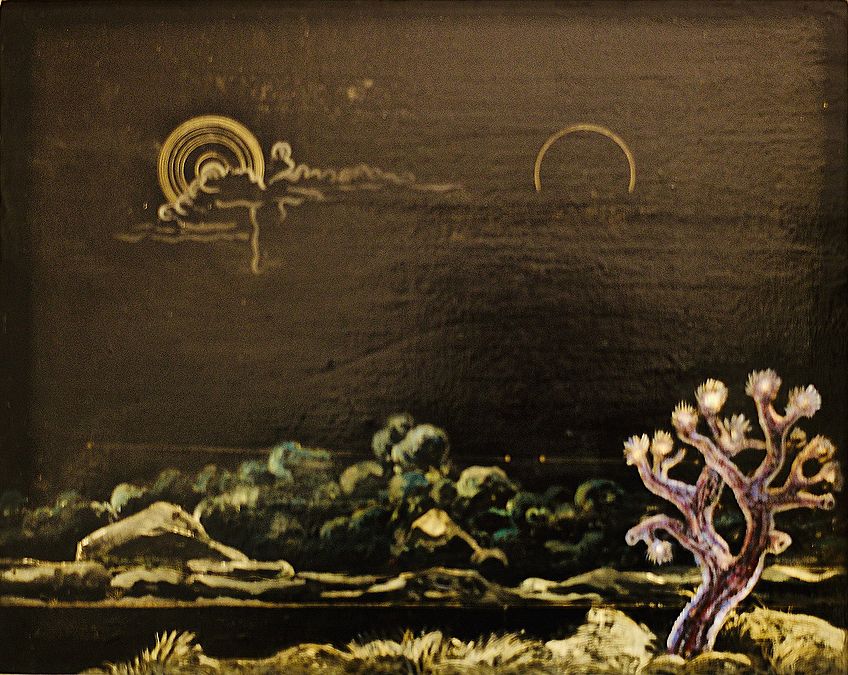 Passage Noir('Black Passage', 1923) past Max Ernst; Pedro Ribeiro Simões from Lisboa, Portugal, CC By 2.0, via Wikimedia Commons
These methods were thought to aid viewers to explore the recesses of their subconscious mind by assuasive them to witness the negative spaces left past techniques like frottage and grattage. Frottage is when the creative person creates a textured surface and lightly rubs it with a soft material such every bit a crayon. Grattage refers to when pieces of paint are removed in some way.
Freeform
Surrealism set the bar for a new blazon of art that did not conform to whatever detail manner and was rather defined by its philosophy, ideals, and content. The emphasis on the role of the unconscious in creating art, and the blatant anti-rationalism of the motion translated into freeform artistic expression on the canvas. This was in stark contrast to the rigid, highly structured Cubism that was besides making waves in the art scene in the early to mid-twentieth century.
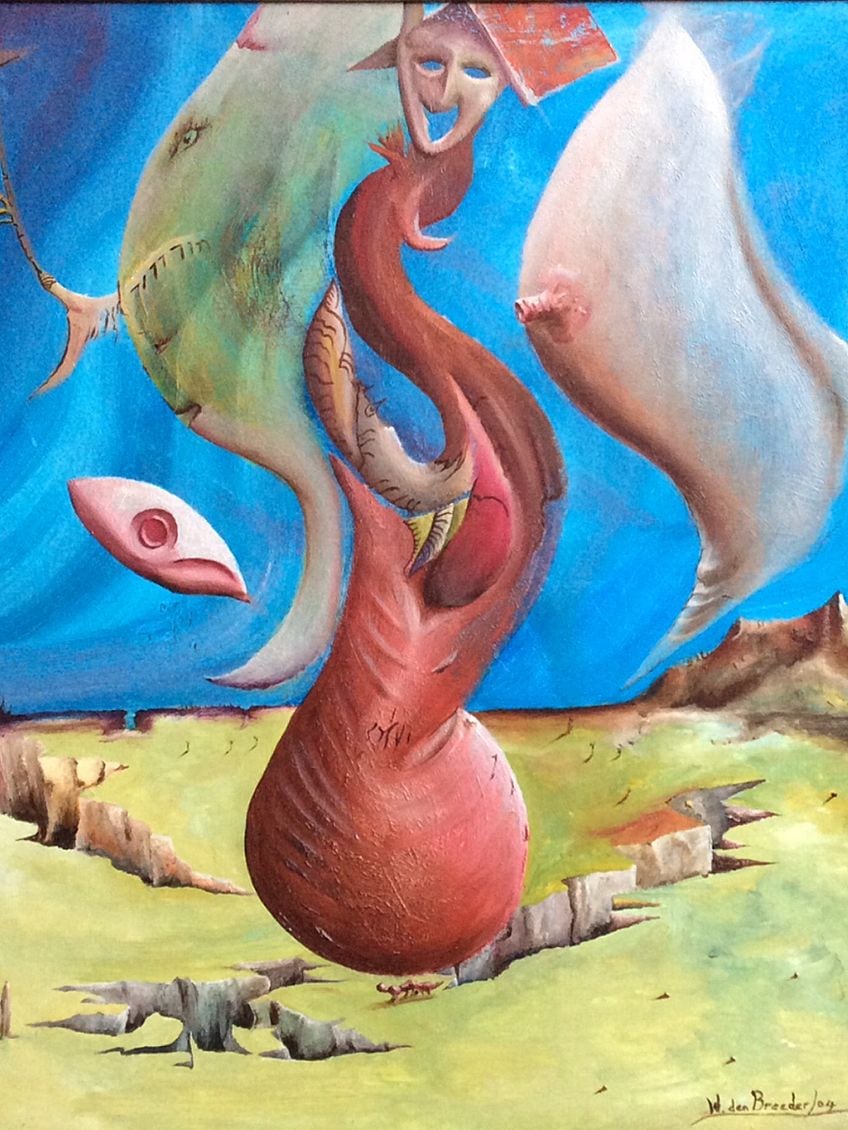 Allereerste Gedachten('First Thoughts', 2004) past Willem den Broeder;Willem den Broeder, CC BY-SA iv.0, via Wikimedia Commons
Surrealism Today
The influence of the thought-provoking and sometimes disturbing images that did emerge from the Surrealist artists' minds continues to capture the attention, prod the marvel and stimulate the minds of audiences fifty-fifty today. Decades subsequently the movement, it continues to influence the art earth. Absurdism, for example, remains strongly inspired by it. The works of Michael Cheval, for case, which grew in popularity in the new millennium, are testimony to the echoes that Surrealism has left in more modern creative minds. Some of the work of Anatole Krasnyansky, an American-Ukrainian water-color artist, also embody the Surrealist content and style.
Surrealism was unlike whatsoever art movement that had gone earlier. Equally a direct response to the atrocities of war, it challenged the socio-political status quo that was held to be responsible for the social problems of the time. Cartoon from theories of the unconscious, its depth was oceanic and transcended the boundaries of space and time. Assuming and innovative in its political statements, it shook the art earth for decades to come up.
Accept a await at our Surrealism webstory here!
Often Asked Questions
What Is the Main Idea of Surrealism?
The Surrealist art move challenged the rationality that was seen to govern early 20th-century French society. It was based on the idea that truthful reality, and creativity, came from the unconscious and that, through the exploration of the unconscious, a superior form of reality could be experienced.
How Is Surrealism Used Today?
Surrealism has afflicted the art (specially in absurdism) as well as the literary and academic world. The famous works of prominent Surrealist figures continue to provide an artery for the expression of taboo subjects, feelings, and ideas through two-D and iii-D art, fashion, cinema, and literature.
What are the Characteristics of Surrealism?
Beingness an abstract art that is not confined to a specific fashion, Surrealist art can take many forms. You may identify information technology by the use of distorted images, dreamscapes, symbolism, and the bizarre representation and combination of ordinary objects. It is known for existence cool and provoking a range of responses.
What Is an Instance of Surrealism?
During the early 1920s, several well-known artists belonged to the Surrealist Movement. These included Salvador Dali and Pablo Picasso. 1 of the nigh famous pieces is The Persistence of Memory by Salvador Dali.
What Are Some Techniques Used to Make Surrealism Art?
Automatism is a popularly used technique that allows the artist to express their unconscious, without their fine art being divers by the rational mind. Surrealism involves uninhibited artistic expression. Frottage and Grattage are also commonly used, which allows the viewer to meet negative spaces and thereby promotes lateral thinking and the exploration of their minds. Frottage is when color is rubbed lightly over a textured surface. Grattage refers to the removal of paint later on it has been applied.
Source: https://artincontext.org/surrealism-art/
Belum ada Komentar untuk "Which Surrealist Artist Was Influenced by the Way That Children Made Art?"
Posting Komentar